Best AI Resume Writer for Recruiters: What to Look For
1. Problem
Most AI writing tools are built for individual users, not recruiter workflows. They optimize for fast output, not submission quality consistency across multiple candidates and requisitions.
Recruiters need repeatable quality under monthly volume constraints. A tool that produces one good resume out of five still creates operational drag and review risk.
The evaluation question is not who writes the prettiest bullet. It is which system helps your team consistently deliver role-fit submissions that hiring managers trust.
Where Signal Breakdown Happens
- Output quality varies wildly candidate to candidate
- No recruiter-level controls for quota, review, and approvals
- Minimal ATS diagnostics or requirement mapping
- No transparent explanation of what changed
- Tool cannot support multiple concurrent requisitions cleanly
2. Recruiter Reality
Recruiter teams are judged by speed and quality together. Fast but weak submissions damage trust with hiring managers. Slow but perfect workflows cannot scale active pipelines.
Best-in-class tooling therefore combines orchestration with transparency. The system should show intake logic, strategy decisions, and output deltas clearly.
For leadership teams, candidate-level analytics and rewrite usage visibility are critical for improving consistency over time.
What Recruiters Check in the First Pass
- Role-specific strategy before rewrite generation
- Side-by-side diff and reasoned change visibility
- ATS and keyword diagnostics tied to each JD
- Account-level usage and quota tracking
- Clean exports and stable formatting for client submissions
3. Optimization Breakdown
Evaluate tools using a 30-day pilot with real requisitions. Measure submission speed, manager feedback quality, and interview conversion deltas across the same role families.
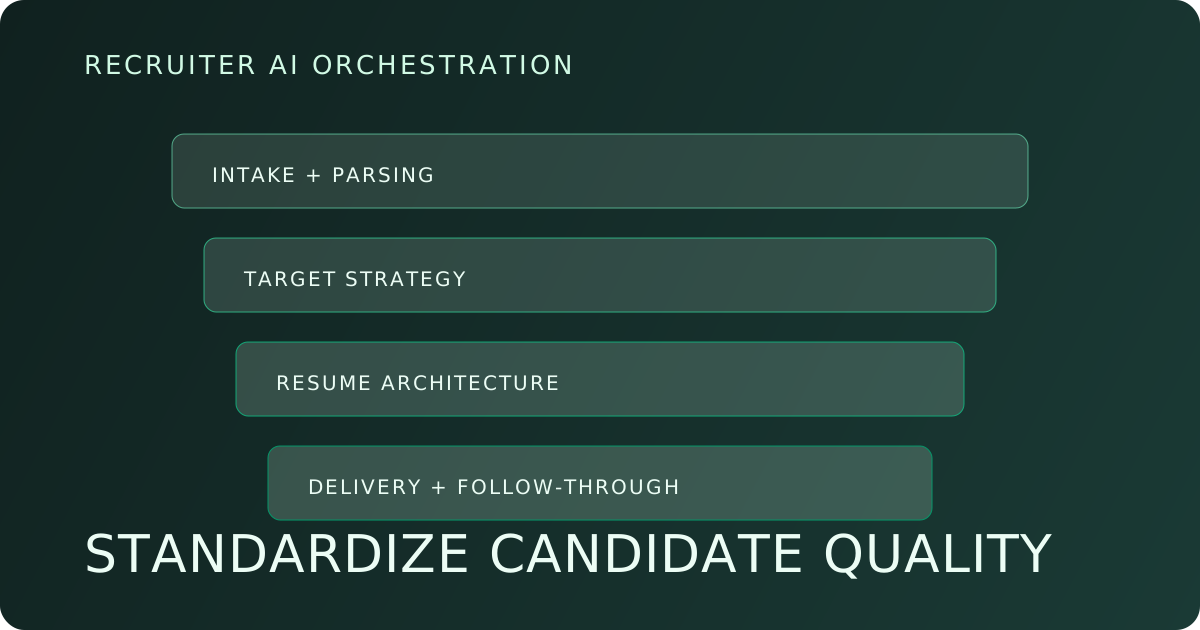
Require workflow separation: intake agent, strategy agent, architecture agent, and delivery agent. This creates reliability and makes failures easier to debug.
Demand transparency artifacts: strategic notes, diff output, and candidate-level activity history. Without those, scale introduces hidden quality drift.
Execution Framework
- Run pilot with at least 25 candidate rewrites across 3 role clusters
- Track output acceptance rate by hiring managers
- Track rewrite-to-interview conversion changes
- Validate quota controls for Starter vs Pro usage
- Audit sample outputs for truthfulness and role fit
- Require admin and recruiter dashboards with separate scopes
Quality-Control Checklist
- At least 80% of outputs pass internal recruiter review
- Diff output is available for every generated rewrite
- ATS checks surface actionable issues, not generic tips
- Candidate activity remains visible per recruiter account
- Tool handles high-volume periods without quality collapse
Implementation Notes
Implementation quality improves when resumes are reviewed against a fixed scorecard before export. In practice, this means checking requirement coverage, measurable evidence, and section clarity in one pass, not in separate ad hoc edits.
Teams that operationalize this review loop usually see better recruiter consistency within 2 to 4 weeks because each candidate submission follows the same quality standard.
Common Failure Modes
- Optimizing wording before confirming target role direction
- Adding keywords without measurable context
- Retaining low-signal bullets that dilute strong evidence
- Over-formatting in ways that reduce ATS parse stability
- Submitting without final diff and ATS review
4. Example Before/After
Before: "Candidate summary rewritten for clarity and professionalism."
After: "Candidate narrative re-architected around target role requirements, with measurable recruiting outcomes and ATS-aligned evidence that hiring managers can validate quickly."
Why the After Version Converts Better
- Shifts from cosmetic edit to requirement-led architecture
- Adds measurable evidence for recruiter trust
- Improves handoff quality to hiring managers
- Supports repeatable team-level quality standards
5. Subtle Call to Action
If your team wants consistent candidate optimization at scale, test the workflow in the Recruiter Platform and execute rewrites in the Studio.
Use a controlled pilot and compare acceptance quality before committing to broader rollout.