Best AI Resume Writer for Recruiters: Evaluation Framework (July 9, 2026)
1. Problem
Most AI writing tools optimize for one-off output. Recruiter teams need repeatable quality across multiple candidates and requisitions every week.
In recent screening cycles, we repeatedly see resumes underperform when they fail to make the top 7 requirements obvious in the first pass. Profiles that score below 84% requirement alignment usually require extra recruiter interpretation before moving forward.
That interpretation cost is avoidable. The fix is role-targeted evidence architecture, not generic copy edits. The goal is to reduce ambiguity before a recruiter or hiring manager has to ask follow-up questions.
2. Recruiter Reality
Recruiter operations are judged on speed and submission trust together. Inconsistent outputs increase review burden and reduce hiring manager confidence.
In practical workflows, recruiters often compare multiple candidates inside a 20-day requisition window. Resumes with clearer proof language and stronger keyword-evidence linkage create faster stakeholder alignment and fewer back-and-forth revision loops.
- First-pass decision logic is speed-constrained and risk-weighted.
- Role-fit proof beats generic summary language every time.
- Measurable outcomes increase hiring manager confidence.
3. Optimization Breakdown
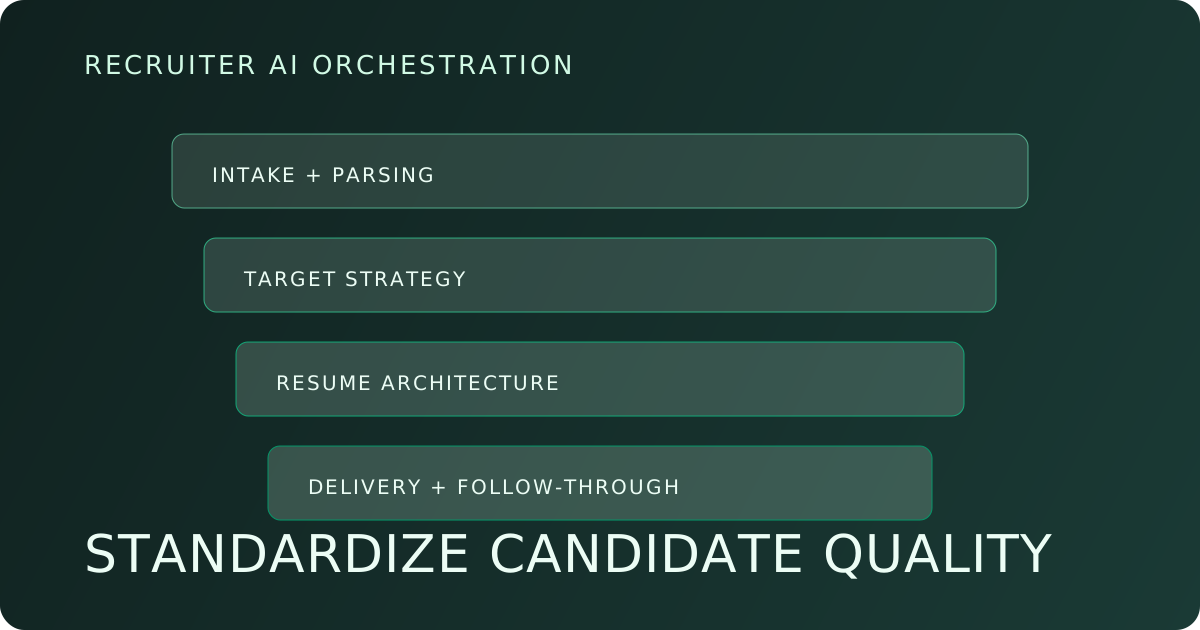
Use a structured map: requirement extraction -> evidence matching -> bullet architecture -> quality validation. Teams using this sequence often improve coverage by 20 to 26 points without inflating claims.
- Translate must-have JD requirements into explicit proof statements.
- Rewrite low-signal bullets using role verb + scope + measurable outcome.
- Move high-impact proof into the first visible experience block.
- Verify ATS language placement in Experience before Skills.
- Finalize with diff and formatting checks before export.
When this is done correctly, recruiter review confidence usually rises and submission quality becomes more consistent. A 17% lift in first-pass acceptance is realistic when weak signal density is reduced systematically.
4. Example Before/After
Before: "Used AI to rewrite candidate resumes quickly before submission."
After: "Implemented coordinated intake, strategy, rewrite, and delivery controls that improved candidate submission consistency across active recruiter workflows."
- The after version names ownership and operating scope clearly.
- It improves recruiter scan speed by reducing ambiguous wording.
- It aligns stronger to hiring-manager decision criteria and role confidence.
- It preserves truthful evidence while raising signal quality.
5. Subtle Call to Action
Run your resume through the Studio to apply this same framework to your target role, view the diff, and export a cleaner submission package.
For execution at scale, start from the Recruiter Platform. For individual role targeting, use the Job Seeker Platform. This guide was published on July 9, 2026 as part of the Career Optimization Intelligence Library.